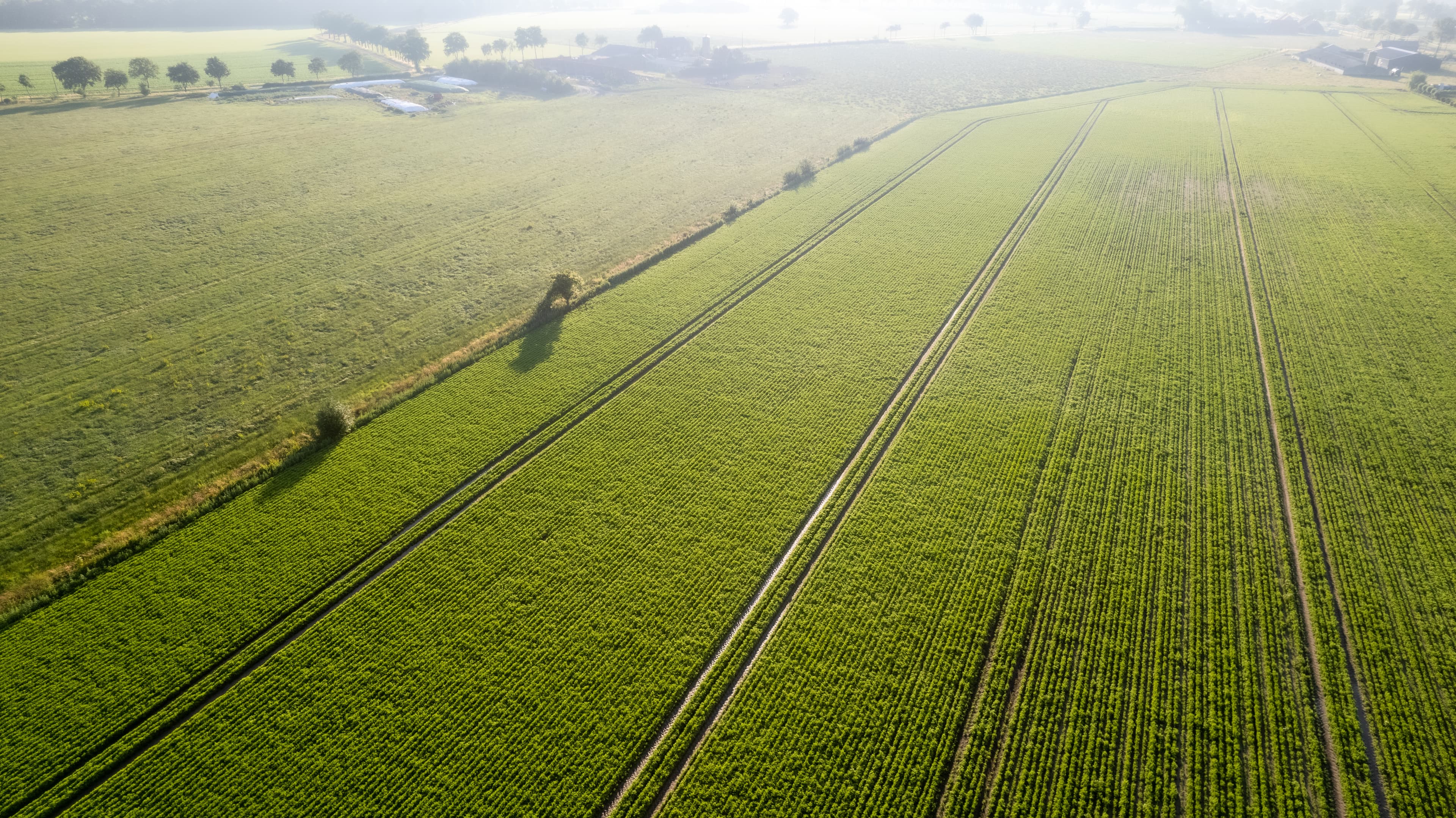
+6.2% Soybean Yield From Two Foliar Sprays
A 2024/25 replicated trial in Botucatu, São Paulo on HO Iguaçu IPRO showed that two Agrarius applications at V4 and R1 (500 mL/ha each) lifted yield 6.2% to 4,338 kg/ha, added 10.4% more pods per plant, and raised carboxylation efficiency 14.3% — without changing the rest of the program.
The Problem
Soybean profitability isn't decided by how much you spend on inputs — it's decided by how efficiently the plant turns those inputs into pods, grains, and harvested weight. Higher fertilizer rates and more aggressive crop protection no longer reliably buy proportional yield.
The lever most operators haven't pulled is the one inside the plant: photosynthetic efficiency, reproductive development, and stress tolerance through the critical R-stages.
The Trial
A 2024/2025 replicated trial in Botucatu, São Paulo on HO Iguaçu IPRO (Maturity Group 6.4, indeterminate) tested two foliar Agrarius applications against an untreated control under standard commercial management.
- Location: Botucatu, São Paulo
- Variety: HO Iguaçu IPRO
- Season: 2024/2025
- Protocol: 500 mL/ha at V4 and again at R1
- Season investment: 1 L/ha total
- Design: replicated plots, randomized
What Happened
Yield rose comprehensively — pods, grains, and grain weight all moved in the right direction. Plant physiology measurements explained where the gain was coming from.
- Yield: 4,338 kg/ha treated vs. ~4,100 kg/ha control — +6.2% (about +238 kg/ha).
- Pods per plant: +10.4% — better flower-to-pod conversion.
- Grains per plant: +9.2% — successful pod fill.
- 100-grain weight: +1.54% — modest but positive.
- Total chlorophyll: +4.87% — more capacity to capture light.
- Carboxylation efficiency: +14.3% — more CO2 fixed into biomass per unit time.
- Oxidative stress: −8.06% — plants stayed in metabolic balance through reproductive growth.
Treatments with full standard inputs and Agrarius performed best; aggressive 25% input reductions blunted the response, and moderate 10% cuts still held yield.
Why This Matters
A 6.2% yield gain on a typical commercial soybean operation is meaningful margin.
- On a 40 bu/ac baseline, that's +2.5 bu/ac.
- At $10/bu, that's $25/acre in additional revenue.
- On a 500-acre farm: +$12,500/season, scaling linearly with size.
The path to that gain matters too. Yield came from physiological efficiency — the plant working smarter — not from extra inputs. That makes the gain compounding rather than one-off, and it sits well alongside reduced-input programs growers want to run anyway.
How To Use It
Two timings, both within standard soybean spray windows.
- V4 (~30–35 DAE): when the fourth trifoliate fully expands.
- R1 (~45–55 DAE): at first open flowers.
- Rate: 500 mL/ha per application; 1 L/ha season total.
- Equipment: standard foliar sprayer.
- Tank-mix: compatible with foliar fungicides, insecticides, and micronutrient programs.
- Fertilizer: modest 10% input reduction is workable; aggressive 25% cuts reduced the yield response.
The Growers Choice
Try Agrarius and experience the results for yourself, fully backed by our performance guarantee program